Professional January Winter Decor DIY Tips That Make a Real Difference
It’s 4:15 on a gray Tuesday, the tree is boxed up, and the living room looks like it’s holding its breath. The light is already going blue at the windows. That’s the moment january winter decor diy was made for.
Below are 19 designer-tested rules, each one doable with thrifted pieces, hardware-store supplies, and whatever is already in the house. Read them as a sequence: materials first, then light, then scale and arrangement.
The professional rules behind january winter decor diy
Dried eucalyptus stems in a stoneware pitcher

Dried eucalyptus holds its dusty gray-green for 6 to 8 weeks with zero water, which is exactly the lifespan January needs. Cut stems to 20 to 24 inches and let them fan out of a heavy pitcher. The matte stoneware and the papery leaves give you texture without a single bloom.
This suits small side tables where fresh flowers would wilt in dry, heated air. Skip anything sprayed with glitter. It sheds into carpet for months.
Faux snow spray on windows is a trap

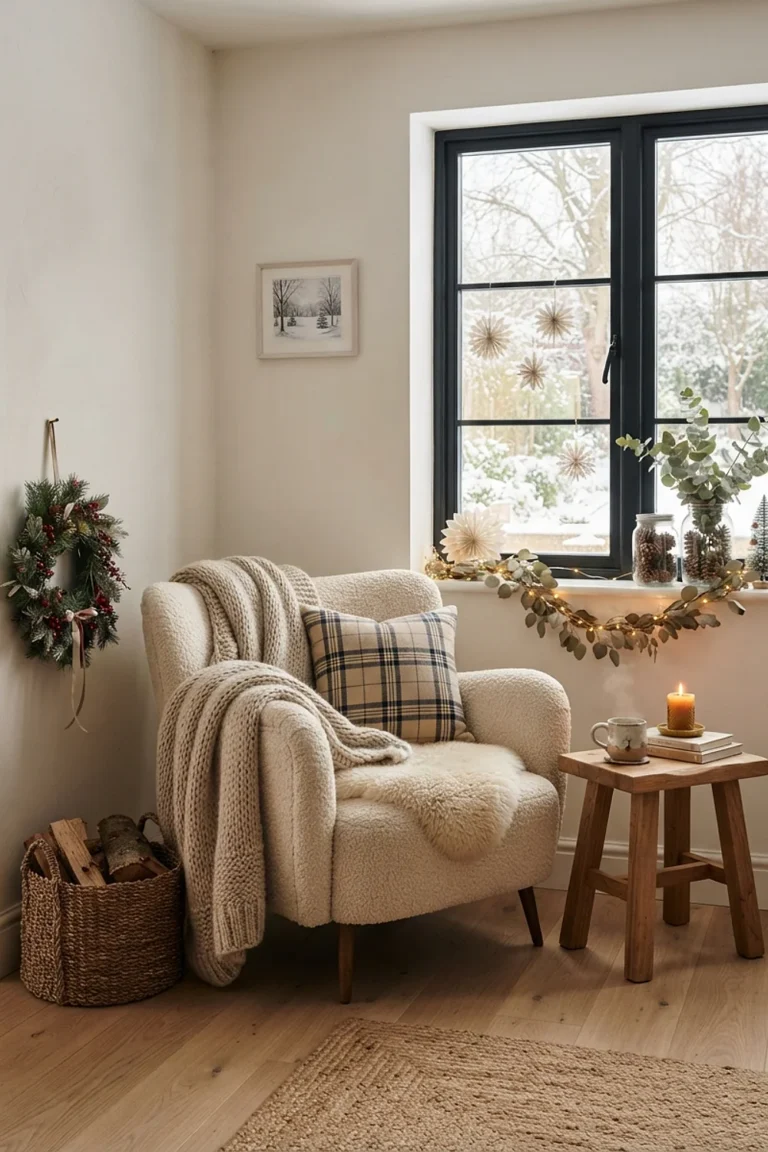
Aerosol snow looks fine on day one and chalky by day four, and it needs a razor blade to remove. Cut paper snowflakes taped to the inside of the glass give the same frosted effect and peel off clean. Fold 6-inch squares of printer paper into sixths, then snip.
Kids can help with this one. Tape the flakes at varied heights, not in a grid, or the window reads like a classroom border.
Battery taper candles on a timer

Flameless tapers with a 5-hours-on, 19-hours-off timer give you a glow at the exact hour the room needs it. Pick ones with a warm amber flicker and a real wax shell, because the plastic ones glint under direct light. Set them in brass or ceramic holders at varying heights.
This is the right call for renters, pet owners, and anyone with a draft near the mantel. Real candles in a moving-air spot drip and smoke.
A thrifted wool blanket draped over one arm of the sofa

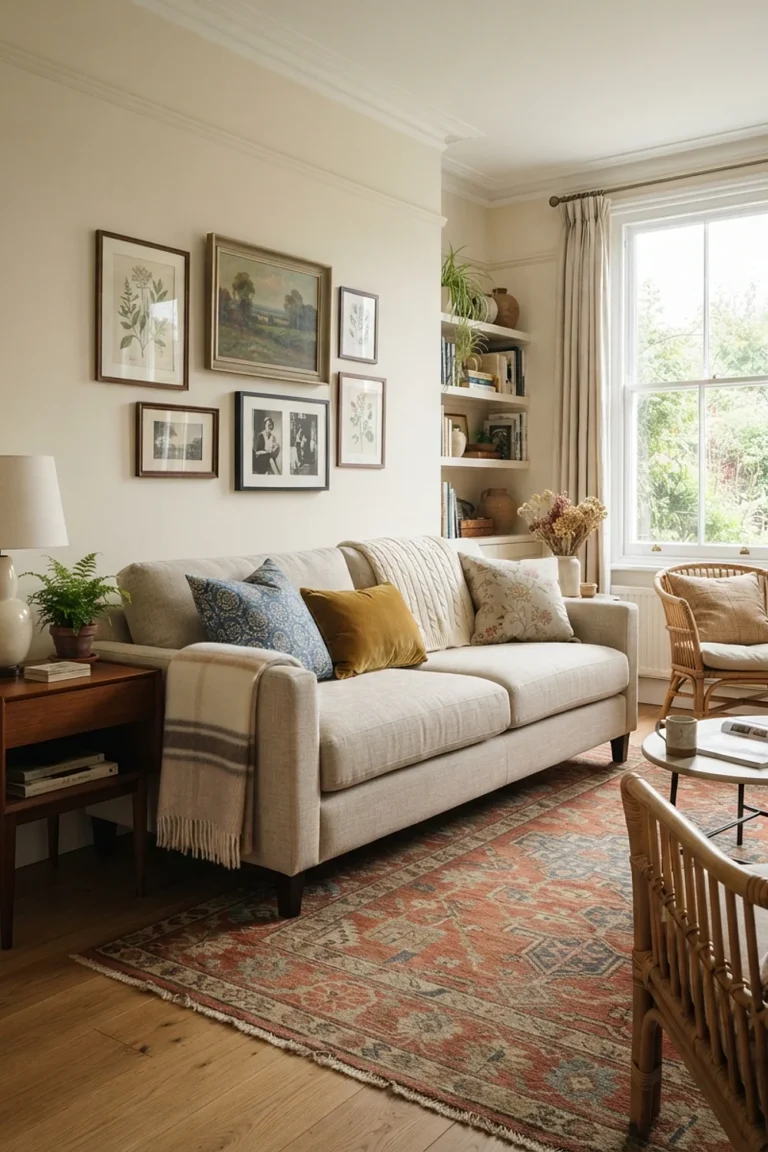
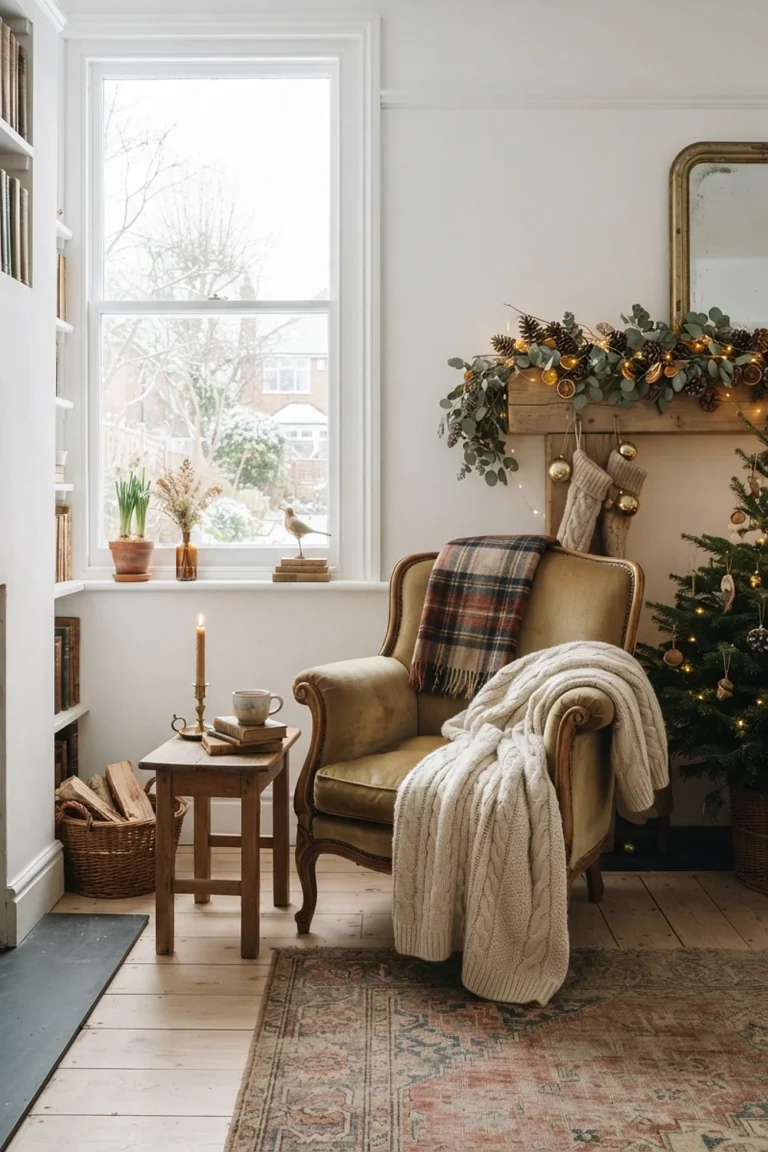
A secondhand Pendleton-style wool blanket runs about $12 to $25 at a thrift store, against $120 or more new. Pick oatmeal, charcoal, or a muted plaid, and fold it lengthwise in thirds so it drapes about 14 inches over the arm. The wool is scratchy for a minute, then warms under your hand.
It works best in living rooms where people actually sit. Check for moth holes by holding it up to a window.
Pinecones with white-tipped paint in a wooden bowl

Bake foraged pinecones at 200°F for 30 minutes to close up any bugs and open the scales, then dab the tips with white craft paint. Heap them in a shallow dough bowl, 12 to 16 inches wide. The contrast between rough bark and chalky tips reads like frost.
Use this on a coffee table or dining table where it sits at eye level. Avoid scenting them with cinnamon oil, which stains wood.
A galvanized bucket by the door holding split birch logs

A 10-quart galvanized pail costs around $9 and holds six to eight birch logs, which is enough visual weight for an entry or beside a fireplace. The silver-gray metal and papery white bark sit well together. Even without a fireplace, the logs read as winter.
Make sure the bark is dry before it comes indoors. Damp logs leave a ring on hardwood.
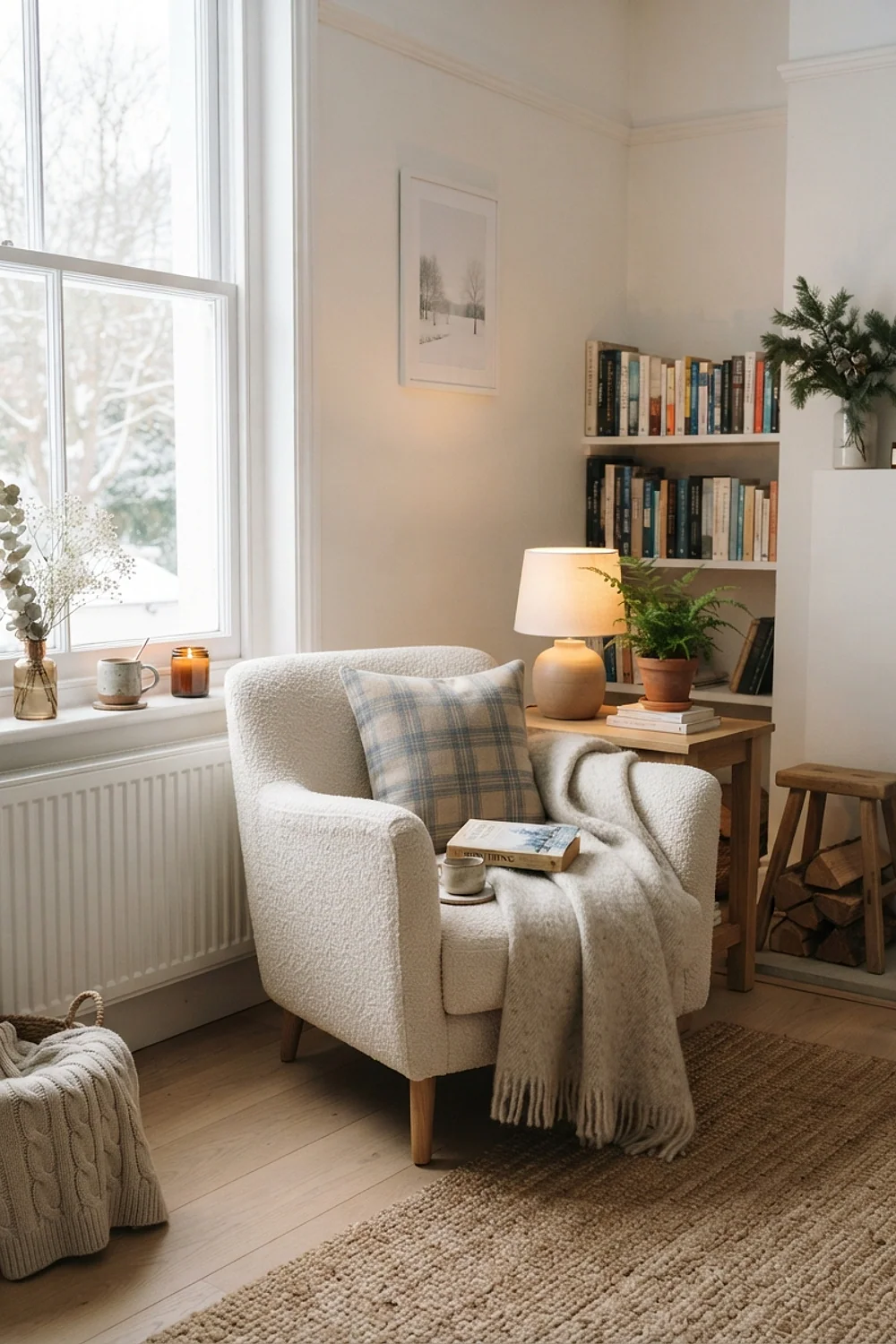
Pulling the armchair 18 inches toward the window

Shifting one chair toward the glass turns a dead corner into a reading perch that catches the last 40 minutes of daylight. Angle it about 30 degrees toward the room so it still joins the conversation. Floating furniture off the wall almost always makes a room feel larger.
This suits living rooms with a bare window wall. Leave at least 30 inches of walkway behind it.
One tall branch arrangement beats five small vases

A single 36 to 40 inch branch of bare birch or pussy willow in a floor vase reads as a deliberate gesture. Five small vases of mixed greenery read as clutter, like a shelf of appliances nobody put away. Odd, tall, and singular wins in a corner.
Put it where ceilings run 8 feet or higher. In a low room, shorten to 30 inches or it will crowd the light fixture.
Warm 2700K bulbs and string lights inside glass jars

Swapping a 4000K bulb for a 2700K one costs about $3 and changes the whole evening. Add a coil of micro LED string lights inside a quart jar, about $8 for a 10-foot strand, and the glow spreads without glare. Counterintuitively, dimmer light looks warmer even if the wattage is identical.
Group three jars on a shelf at different heights. Avoid cool-white strands, which make winter rooms feel like a hospital hallway.
A three-color palette of navy, oatmeal, and brass

January light is thin and bluish, so deep navy looks richer against it than it does in July. Oatmeal softens the navy, and brass gives it a glint. A blue such as Benjamin Moore Hale Navy shows the idea, but a navy pillow cover does the same job for a fraction of a repaint.
This fits anyone who hates visual noise. Hold the rule to three colors plus natural wood, or the room starts looking like a swatch book.
Material and arrangement rules for january winter decor diy
Air-dry clay snowflake ornaments on a bare branch

A 1-pound block of air-dry clay costs about $6 and makes around 20 ornaments. Roll it to 1/4 inch, cut with a cookie cutter, poke a hole, and let it dry for 24 hours. The finish is chalky and matte, closer to bisque porcelain than plastic.
These stay up through February because they aren’t tied to Christmas. Seal them lightly if the room is humid, since unsealed clay softens at the edges.
Leftover red and green is the quiet giveaway

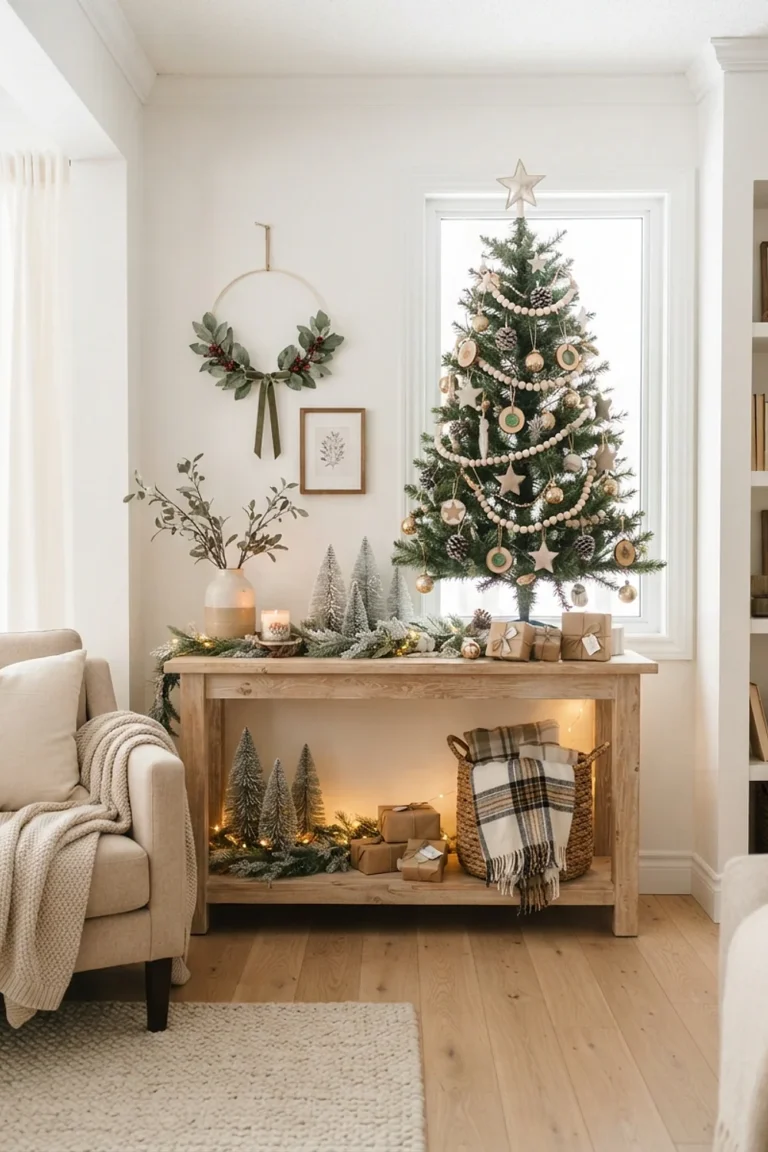
Holly-red ribbon and bright green garland left up past January 6 make a room look stalled. Swap them for cream, gray, and bare wood within a single afternoon. The room reads as winter rather than as an unfinished holiday.
If sentimental pieces must stay, move them to one shelf. Concentrating them in a single place beats scattering them as clues all over the house.
A boot tray lined with river rock at the entry

A 30-by-15-inch rubber boot tray filled with an inch of smooth river rock lets slush drain away from the floor. The stones look intentional, and the gray tones suit January. It costs less than a decorative entry mat and handles wet boots far better.
This is the call for anyone with hardwood or tile at the door. Rinse the stones monthly to keep salt residue from crusting.
A velvet cushion cover in a deep winter tone

A cotton-velvet cushion cover in forest green or burgundy changes the feel of a sofa in seconds. Run your hand against the nap and it goes darker, which gives depth in flat light. Stuff it with an insert one size larger, a 22-inch insert in a 20-inch cover, for a plump look.
Choose cotton velvet over polyester if you have kids, since it hides crumbs better. Hand-wash cold or spot clean to protect the pile.
A stack of three books with a candle on top

Three hardbacks in neutral jackets, stacked 8 to 10 inches high, make a perfect plinth for a candle or small bowl. Turn the spines outward and keep the largest book at the bottom. Cloth-bound covers in cream and gray look best.
Use this on a nightstand or console where surface space is tight. Don’t stack more than four books or the pile starts to tilt.
A woven laundry basket as blanket storage

A 20-inch woven seagrass laundry basket, thrifted or around $18 new, holds four throws and still looks like furniture beside the sofa. The woven texture adds depth against smooth upholstery. Blankets belong where people reach for them, not in a closet.
It fits best in small living rooms without a trunk or ottoman. Line it with a pillowcase if the weave catches wool fibers.
A cleared windowsill with a row of jars

Clearing a windowsill of every random object and lining up three to five clear jars, each 5 to 7 inches tall, reads as calm. Fill them with epsom salt, cotton balls, or dried lavender. The jars catch the thin winter sun and throw soft light across the sill.
This suits deep sills of 4 inches or more. Skip it where a radiator sits directly below, since the heat clouds glass.
A 24-inch wreath on the front door

A 24-inch grapevine wreath, around $14 at a craft store, fits a standard 36-inch door better than the 16-inch ones that look lost. Wire in a few sprigs of dried lavender or white berries. Hang it at eye level, about 60 inches from the ground.
This works for porches with flat, painted doors. Check how far the door swings so the wreath doesn’t scrape the frame.
Frosted jar lanterns lining the stairs

Brush the outside of a clean jar with a thin coat of white acrylic paint, dab it off with a sponge, and drop in a battery tea light. Space them every second stair so the light pools on the treads. The frosted glass diffuses a flame-like flicker.
Stairs need enough light to be safe, so keep the lanterns to one side. Never use real candles on a stair where someone might trip.
Breaking the rules on purpose
Conventional advice says to keep every surface clear after the holidays. That’s wrong for January. A bare mantel in a room with 8-foot ceilings looks abandoned, so leave one layer in place: a long board of greenery, one mirror, and two candles.
Another sacred rule is matching metals. Mixing brass candlesticks with a galvanized bucket and a black iron hook gives a room more depth than a single finish. Keep the ratio at about 60 percent one metal, 30 percent a second, and 10 percent a third.
The third rule worth breaking is “buy quality once.” For short-lived seasonal pieces, the thrift-store version wins. A $12 wool blanket and $9 pail deliver the same visual effect as $150 of catalog pieces, and nobody mourns them at the February swap.
What went wrong
Most failed winter rooms have the same handful of problems. They’re all fixable in an afternoon.
- Hanging cool-white string lights, which flatten every texture in the room.
- Choosing decor sized like a toaster, small and boxy, when the wall needs something 24 inches or larger.
- Scattering a dozen tiny objects across a shelf instead of grouping three.
- Skipping a natural element, since a room without wood, wool, or greenery feels sealed.
- Storing blankets behind closed doors where nobody will ever grab them.
A fix works best when it starts with removal. Pull half of what’s on a surface, then rebuild with the three-object rule: one tall, one wide, one small.
Also watch the light before buying anything. A room that faces north needs warmer bulbs and paler fabrics than one that faces south, and a $3 bulb solves more than a $60 lamp.
Where to start with january winter decor diy
The best january winter decor diy comes down to restraint: warm light, natural texture, one tall gesture, and a calm palette. Start with the bulbs and the blanket, since both change a room within minutes.
Save or pin this list so it’s ready when the holiday boxes go back up in the attic. For a first project, measure your mantel or front door, then make the pinecone bowl or the 24-inch wreath before buying anything else.