DIY Thanksgiving Decor Mistakes to Avoid Before Guests
It’s 4 p.m. on a gray Wednesday in November, the low sun is slanting across the dining table, and a glue gun is already heating up. That’s the exact moment diy thanksgiving decor ideas tend to go sideways.
The usual problems aren’t about taste. They come from candles too close to dried leaves, centerpieces too tall to talk over, and decor that gets in the way of eating. Here are 22 mistakes and what to do instead.
Diy thanksgiving decor ideas: The vision board
Crowding the table until elbows have nowhere to go
Each guest needs about 24 inches of table width, and a sprawling centerpiece plus a full runner can eat half of that. People end up balancing plates on their knees by the second helping.
Leave a clear strip at least 16 inches wide down the middle and keep everything else low. This matters most on a 6-foot table seating eight, where there’s no spare inch.
Building a centerpiece taller than 12 inches
A tall arrangement turns the table into a wall. Guests lean left and right to find the person across from them, and conversation shrinks to whoever sits beside them.
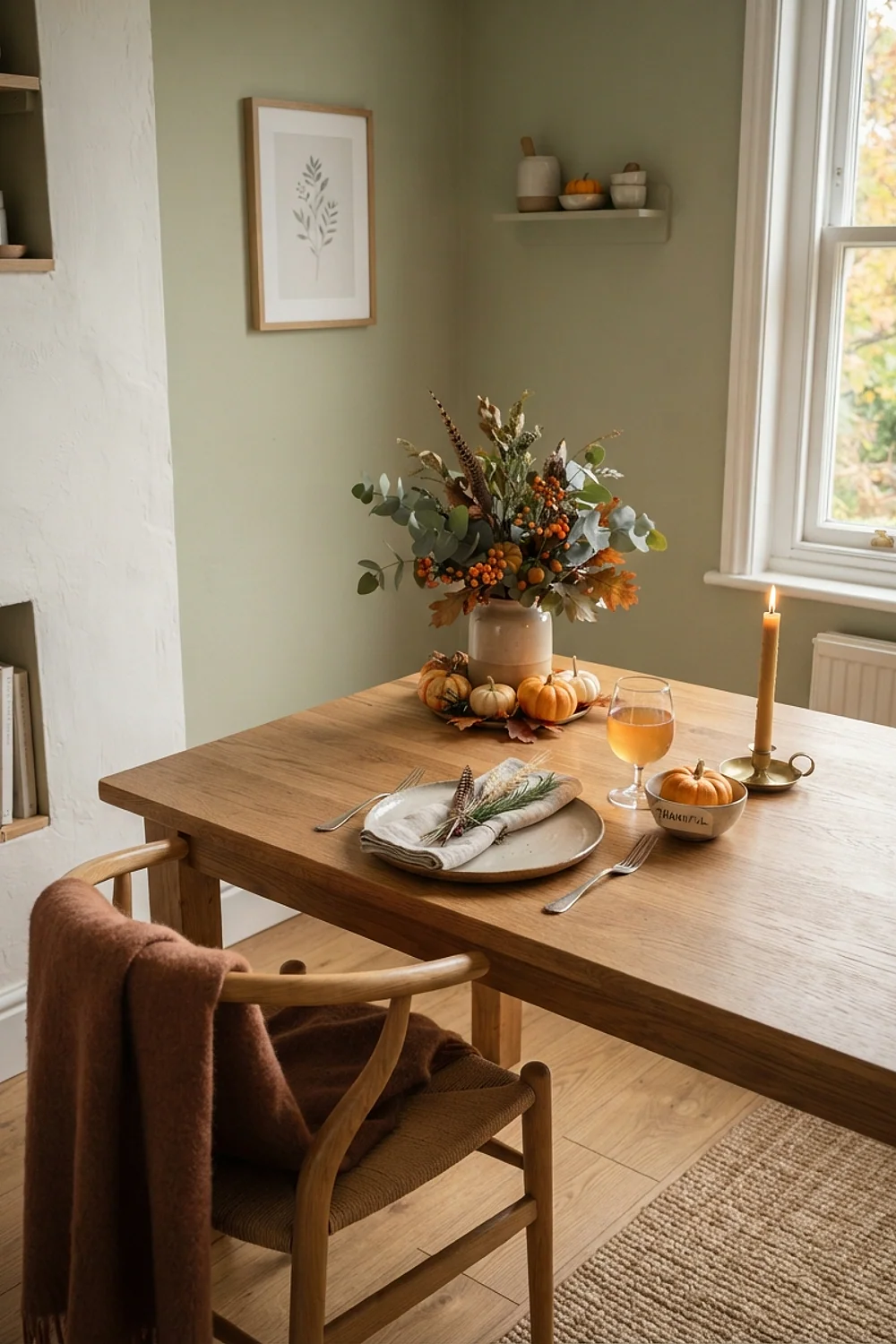
Keep arrangements between 6 and 10 inches, long and low, like a trio of small bud vases down the center. If you want height, hang branches from the ceiling above eye level instead.
Making decor that has nowhere to live in January
Paper garlands, wheat bundles and pressed-leaf wreaths get crushed in a shopping bag on a closet shelf. By next November they’re brittle and flattened.
A 28-quart lidded bin costs about $12 and holds a full season of pieces. Layer tissue between items and toss in a silica packet. This pays off for anyone planning to reuse the same pieces every year.
Relying on one overhead light
A ceiling fixture on full blast flattens every texture in the room. By 5 p.m. in November the daylight is gone, and cool 4000K bulbs turn orange gourds a muddy brown.
Swap in 2700K bulbs, put the fixture on a dimmer, and add lamps on a sideboard. Aim for light that sits below shoulder height, because it makes skin and velvet look better.
Putting flames next to dried foliage
Dried leaves, corn husks and raffia ignite fast. A taper burning an inch from a husk garland is the classic fire hazard of the season. Keep open flames at least 12 inches from anything dry, and never leave them unattended during dinner.
Flickering LED tapers have no flame to catch a husk, look convincing in low light, and are the safer choice around kids and pets. They suit crowded tables where elbows swing near the centerpiece.
Writing place cards nobody can read
Folded cardstock about 3.5 by 2 inches, written in dark ink with lettering at least 24 points tall, stays readable in candlelight. Tiny, curly lettering looks lovely on a craft-store sample and fails at a candlelit table, because an older relative squinting at an 8-point script will skip the card and sit wherever.
Plain block capitals beat fancy script every time here. They suit big family dinners with mixed ages and dim lighting, and a flourish can be saved for a small accent such as a single leaf sketch beside the name.
Gluing things onto real pumpkins
Hot glue peels off a pumpkin as the skin sweats, and the glued spot rots first. An uncut pumpkin lasts two to three months, while a carved one collapses in three to five days.
Use floral pins or wire to attach anything, and save glue for faux pumpkins. For a display that has to last through the long weekend, leave the knife in the drawer.
Lining gourds up like a row of soldiers
Three identical gourds in a straight line read as a shelf, not a display. Grouping in threes helps, but odd numbers aren’t enough on their own, because the eye needs variety to move around a cluster.
The real fix is varied height and shape. Pair one tall Cinderella pumpkin with a squat white one and a warty green gourd, then stagger them off-center. This suits a mantel or console of any size. Just avoid matching sizes, which brings back the row.
Mood board breakdown
Diy thanksgiving decor ideas fail most often in the details guests actually touch, smell and walk past. These next seven mistakes sit in that territory.
Going all orange
A table in pure pumpkin orange looks like a school hallway. The color needs company to look good, and it fights with the warm wood tones in most dining rooms.
Use roughly 60 percent cream or oatmeal, 30 percent deep burgundy or olive, and 10 percent orange as the accent. This suits small rooms best, where saturated color closes in fast.
Styling the buffet like a showroom
Gourds and candles piled down the middle of a buffet leave no surface for platters. Guests hover, and someone ends up balancing a casserole on a radiator.
Keep decor at the two ends and the surface clear, so dishes have room to land and the line moves. Leave at least 36 inches of open floor in front so two people can pass with full plates.
This matters most in narrow dining rooms and open apartments where the buffet sits against a wall. Measure the gap before setting up.
Draping scratchy trim over chairs
Burlap bows and wired garlands on chair backs catch on sleeves and rub against shoulders. Guests lean back, feel the poke, and sit forward for three hours.
A softer move is a cotton-velvet seat pad about 2 inches thick on hard chairs, which adds comfort rather than texture to snag. For a visual cue, tie a linen napkin loosely around the top rail.
This suits long dinners with older guests or hard folding chairs. Keep the napkin knot loose so it never pokes a back.
Hanging an undersized wreath on the front door
A 14-inch wreath on a standard 36-inch door looks like an afterthought from the sidewalk. It disappears completely against dark paint, since a small circle leaves too much bare door around it.
Go for 22 to 26 inches, and expect to pay $30-45 for a full ready-made one. A DIY version on an 18-inch wire frame, bulked up with foliage, reaches that size more cheaply.
This suits budget-minded renters with a plain front door. Skimp on foliage and the frame shows through, so keep stems dense.
Forgetting where coats and scarves will go
A hall table full of pumpkins leaves no landing spot for guests’ wraps and bags. Everything ends up on the host’s bed, and the entry looks cluttered anyway.
A lidded basket about 18 inches wide near the door holds scarves and gloves, and it doubles as decor. This is a good fit for small apartments with no coat closet.
Bulky parkas will not fit inside an 18-inch basket, so plan a rack, a row of hooks or a spare bench for those.
Stringing up cool-white fairy lights
Cool-white LEDs read blue against rust and mustard, and a visible cord looped across a branch looks messy. Battery packs hidden in a vase also die halfway through dinner.
Choose warm white (about 2700K) strands with a built-in timer and fresh batteries. Tuck the pack behind the arrangement so only the glow shows.
Warm light matches candle glow and flatters wood and fabric. This suits mantels and centerpieces far from an outlet, but keep the pack reachable for a quick swap.
Scenting the room with candles and potpourri
Cinnamon-apple candles compete with roasting turkey, and the two smells together are headache-inducing in a closed room. Guests with sensitivities will notice first.
Stick to unscented candles and let the kitchen do the work. If a scent is wanted, simmer a pot of orange peel and cloves on low for the hour before arrival, well away from the table.
Unscented suits small apartments with an open kitchen, where air cannot be separated. Keep the simmer pot topped with water so it never scorches.
Small details, big impact
Dressing the kids’ table in fabric that can’t take a spill
A hand-stitched linen runner at a table of seven-year-olds is a stain waiting to happen. Juice and gravy don’t wash out of loose weaves.
Roll out kraft butcher paper (about $10 a roll) and set out a cup of crayons. It takes spills, doubles as an activity, and goes in the recycling at the end of the night.
This suits any crowded kids’ table, especially when parents are busy at the main one. Tape the edges down so the sheet does not slide, and use washable crayons.
Using shiny plastic leaves
Craft-store leaves have a sheen that catches candlelight and gives them away. They also feel stiff and waxy in the hand, which guests notice when they move a place setting.
Real leaves preserved in a glycerin mix (1 part glycerin to 2 parts hot water) soak for three to six days and come out supple. This works for anyone willing to plan a week ahead.
Theming every object to the holiday
A turkey on the napkins, a turkey on the plates and a turkey on the runner is a lot of turkey. The overall effect turns kitschy fast, because repeating one motif leaves the eye nothing to rest on.
Mix textures instead: weathered wood, linen, brushed brass and matte stoneware. One playful object is plenty.
This approach suits hosts who reuse everyday dishes, since neutral pieces cost nothing extra. A single ceramic turkey or hand-lettered sign is enough. A second one starts the pileup again.
Mixing cool whites with warm autumn colors
A stark bright-white tablecloth makes cream pumpkins look dingy and rust leaves look harsh. The mismatch is subtle but the table feels cold.
Pick warm whites such as oatmeal, ivory or flax linen, and hold a napkin against a gourd in daylight before committing. If the napkin looks gray beside it, swap it out.
Warm tones suit tables with natural pumpkins and candlelight, and the test costs nothing. Check again under evening bulbs, since yellow light can mask a mismatch seen at noon.
Parking one big centerpiece dead center on a long table
On a table over 7 feet long, a single arrangement looks lonely and blocks the middle. Platters have nowhere to land, and the ends feel empty.
Break it into three small clusters spaced about 20 inches apart, with gaps between for serving. That spreads color along the whole length and leaves room for dishes.
It’s not foolproof, since clusters crowd a table under 7 feet or one with many place settings. But for long family-style tables, it works.
Wrapping the stair railing in stiff wired garland
A railing is where a hand lands on every trip up or down, and wired garland with sharp ends scratches palms. Elderly guests lean on it the most.
Use soft bundles of eucalyptus or cotton-stem sprigs tied on with ribbon, and keep the top 2 inches of the rail clear for gripping. Test it by sliding a hand along it.
Misjudging a mantel garland
A garland that barely reaches both ends of a 6-foot mantel looks stretched, and a thin one disappears. The mantel needs visual weight at its edges.
Let it drape about a third of the way down at each end, and vary object heights from 8 to 18 inches. Skip this if a fire will be burning, since the foliage is dry.
The step-by-step process
Diy thanksgiving decor ideas work best when planned in a set order, not bought and arranged all at once. Work through the steps below.
- Measure the table and mark a 16-inch clear strip down the center.
- Choose three colors and a ratio before shopping.
- Set the lighting first, with warm bulbs on a dimmer.
- Style from the center outward, keeping everything under 12 inches.
- Sit in each chair for a minute and check sightlines, reach and elbow room.
That last step catches more problems than any design rule. If a person can’t see across, reach the bread, or rest their arms, the table needs editing.
It’s not foolproof. But it works.
When to call a professional
Most of this list is safe for a weekend project, but a few jobs deserve an expert.
- An electrician for hardwired fixtures, new outlets, or anything that needs a dimmer installed.
- A chimney sweep before a fire burns beneath a garland, since creosote buildup is a real hazard.
- A florist for arrangements serving more than 12 guests, where volume and freshness are harder to control.
- A handyperson for anything hung from a ceiling beam, which needs anchors set into joists, not drywall.
Paying for an hour of professional work costs far less than repairing a scorched mantel. If a project involves heat, wiring or weight overhead, hand it off.
Set the table, then step back
Good diy thanksgiving decor ideas are comfortable first and pretty second. A table that feels easy to sit at, with soft light and room to pass a platter, will always beat a showpiece nobody can use.
Save or pin this list so it’s handy when the decorating starts. Before buying anything, measure the table and mark off that 16-inch clear strip, then build outward from there.